 Support
Use the parcel exactly as it will be handed to the courier, including the box, cushioning and tape. The product’s weight or the dimensions on its retail packaging may not describe the finished shipment.
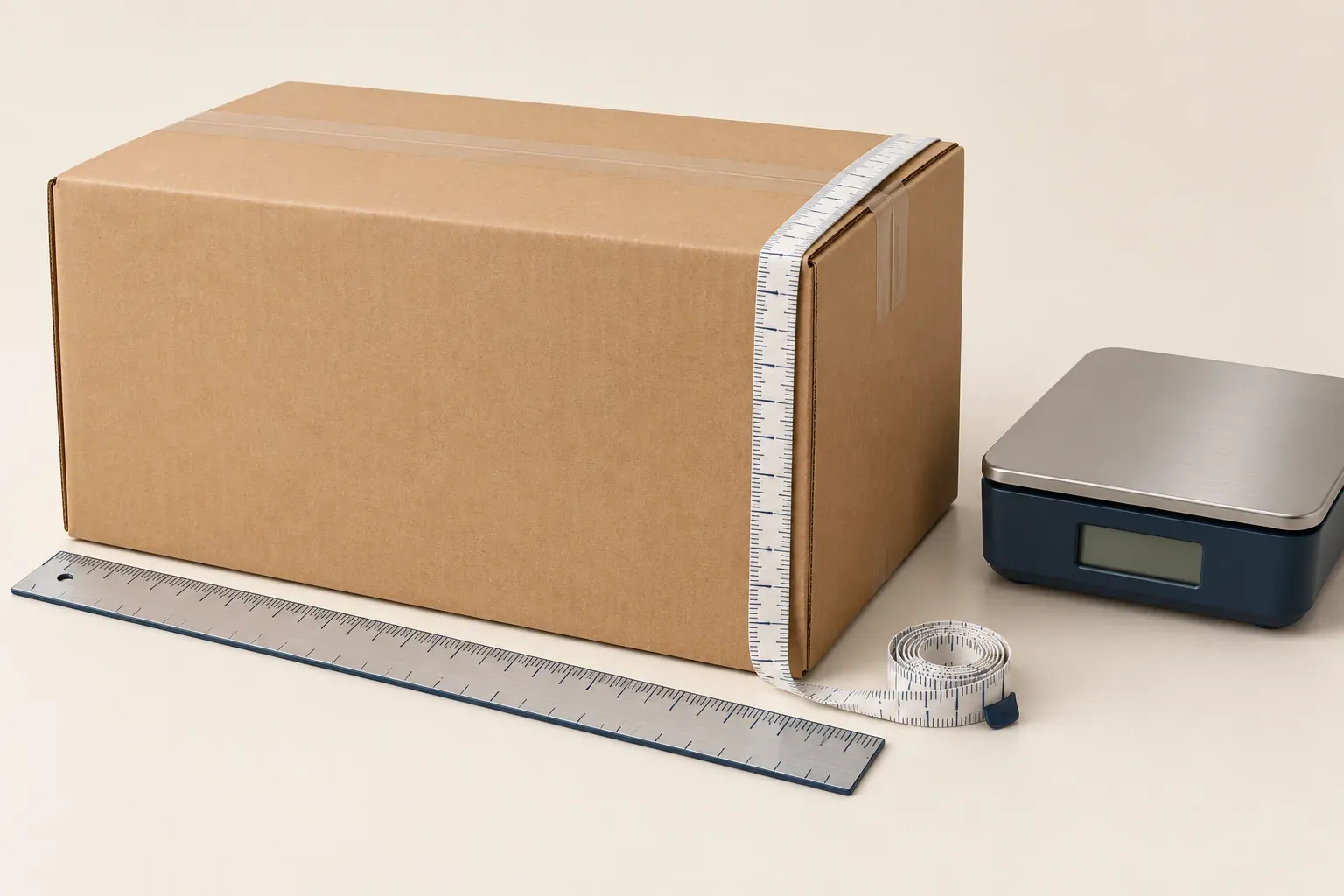
Take the measurements
- Close and seal the parcel. Check that no part extends beyond the main box.
- Weigh the complete parcel on a suitable scale. Include all packaging and check the unit used by the form.
- Measure the outside length, width and height at the widest points. Record all three values in the units requested.
- If the parcel is irregular, measure the full outside space it occupies, including protruding parts.
- For more than one parcel, record the measurements for each piece and check that the selected service accepts that shipment setup.
Actual weight and volumetric weight
Actual weight is what the scale shows. Volumetric weight represents the space a parcel occupies. A light but large box can therefore cost more than its scale weight suggests. The carrier’s calculation, divisor, rounding and charging rules depend on the service.
For example, a box measuring 40 cm by 30 cm by 20 cm has a volume of 24,000 cm³. That volume is not a billable weight by itself. Apply only the method shown for the selected service; there is no single divisor to assume for every carrier.
If the final charge differs
Compare the carrier’s measured values with your original submission. Check whether the difference concerns weight, dimensions, the number of pieces or another service charge. Keep photographs of the parcel on the scale and beside a measuring tape if you need support to review a discrepancy.
Related: what makes up a shipping rate.